
Planning your 2027 marketing budget? Discover how to allocate advertising dollars across Google Ads, social media, Streaming TV, and programmatic advertising to maximize business results.
As 2026 comes to an end, business owners are facing a familiar question:
Where should we invest our marketing budget next year?
With more advertising channels, evolving technology, and increasing competition for consumer attention, deciding where to spend your marketing dollars can feel overwhelming.
Should you invest more in Google Ads? Focus on Facebook and Instagram? Explore Streaming TV? Or continue using traditional advertising?
The answer isn't necessarily choosing one platform over another.
It's about building a marketing strategy where every dollar has a purpose.
Let's explore how small and midsize businesses can approach their 2027 advertising budgets more strategically.
1. Start With Business Goals, Not Advertising Platforms
Before deciding how much to invest in any advertising channel, ask yourself one important question:
What do we actually want our marketing to accomplish?
Different business objectives require different strategies.
- Brand awareness: Introduce your business to new potential customers.
- Lead generation: Generate calls, inquiries, appointments, or form submissions.
- Website traffic: Bring qualified visitors to your website.
- Physical store visits: Encourage customers to visit your location.
- Customer retention: Stay connected with existing customers and encourage repeat business.
For example, a new restaurant may prioritize awareness and local visibility, while an established medical practice might focus on generating qualified appointment inquiries.
Your business goals should determine your advertising strategy—not the other way around.
2. Google Ads: Capture Customers Already Looking for You
Google Ads remains an important channel for businesses that want to reach people actively searching for specific products or services.
Imagine someone searching for:
- "Best dentist near me"
- "Auto repair in Tucson"
- "Window shades in Yuma"
- "Financial services near me"
These searches can indicate immediate interest or purchase intent.
Why consider Google Ads in 2027?
Google Search advertising can be particularly effective when your business offers something people already know they need.
However, competition, search volume, and cost per click can vary significantly by industry and location.
NJO Media Tip: Don't evaluate your search campaigns exclusively by clicks. Track qualified leads, phone calls, appointments, and actual conversions whenever possible.
3. Facebook & Instagram: Reach the Right Audience Before They Search
Not every potential customer is actively searching for your services.
Sometimes, people need to discover your business before they even realize they need what you offer.
That's where Meta advertising—Facebook and Instagram—can play an important role.
These platforms allow businesses to reach audiences through a combination of geographic targeting, eligible audience signals, creative messaging, and campaign optimization.
For many local businesses, Meta can support:
- Building brand awareness
- Promoting products and services
- Generating leads
- Encouraging website visits
- Reengaging existing customers through eligible custom audiences
NJO Media Tip: Strong creative matters. Test different messages, visuals, and calls to action instead of relying on a single advertisement.
4. Streaming TV: Big-Screen Advertising Is No Longer Just for Big Brands
Remember when television advertising seemed accessible only to businesses with massive budgets?
That landscape has changed.
Connected TV (CTV) and Streaming TV advertising allow businesses to reach audiences watching eligible streaming content on internet-connected televisions.
Depending on the advertising platform and available inventory, advertisers can use geographic and audience targeting to reach relevant viewers.
This can make Streaming TV an attractive option for local and regional businesses looking to build brand awareness.
What makes Streaming TV interesting for 2027?
- Large-screen advertising experiences
- Geographic targeting opportunities
- Access to eligible ad-supported streaming inventory
- Opportunities to complement other digital channels
- Campaign reporting that goes beyond traditional television estimates
Streaming TV may be especially useful for businesses that want to establish recognition and credibility within a specific market.
NJO Media Tip: Streaming TV should be part of a broader strategy. Pairing awareness campaigns with search, social, or other digital advertising can help reach customers at different stages of their journey.
5. Programmatic Advertising: Reach Customers Across the Digital Landscape
Consumers don't spend all their time on Google, Facebook, or Instagram.
They read articles, use mobile apps, watch videos, listen to digital audio, and browse countless websites.
Programmatic advertising helps businesses reach audiences across eligible digital environments through automated media buying.
Depending on the platform, campaign objectives, and available data, businesses may be able to use:
- Geographic targeting
- Contextual targeting
- Audience segments
- First-party customer data
- Retargeting
- Cross-channel campaign strategies
One of programmatic advertising's biggest advantages is its flexibility.
A business can use different advertising formats and targeting approaches to support awareness, consideration, and conversion objectives.
NJO Media Tip: Focus on reaching relevant audiences rather than simply purchasing the cheapest impressions. Lower media costs don't automatically mean better business results.
6. How Much Should You Allocate to Each Channel?
There isn't a universal formula that works for every business.
Your ideal allocation depends on your industry, audience, market, competition, available budget, and business objectives.
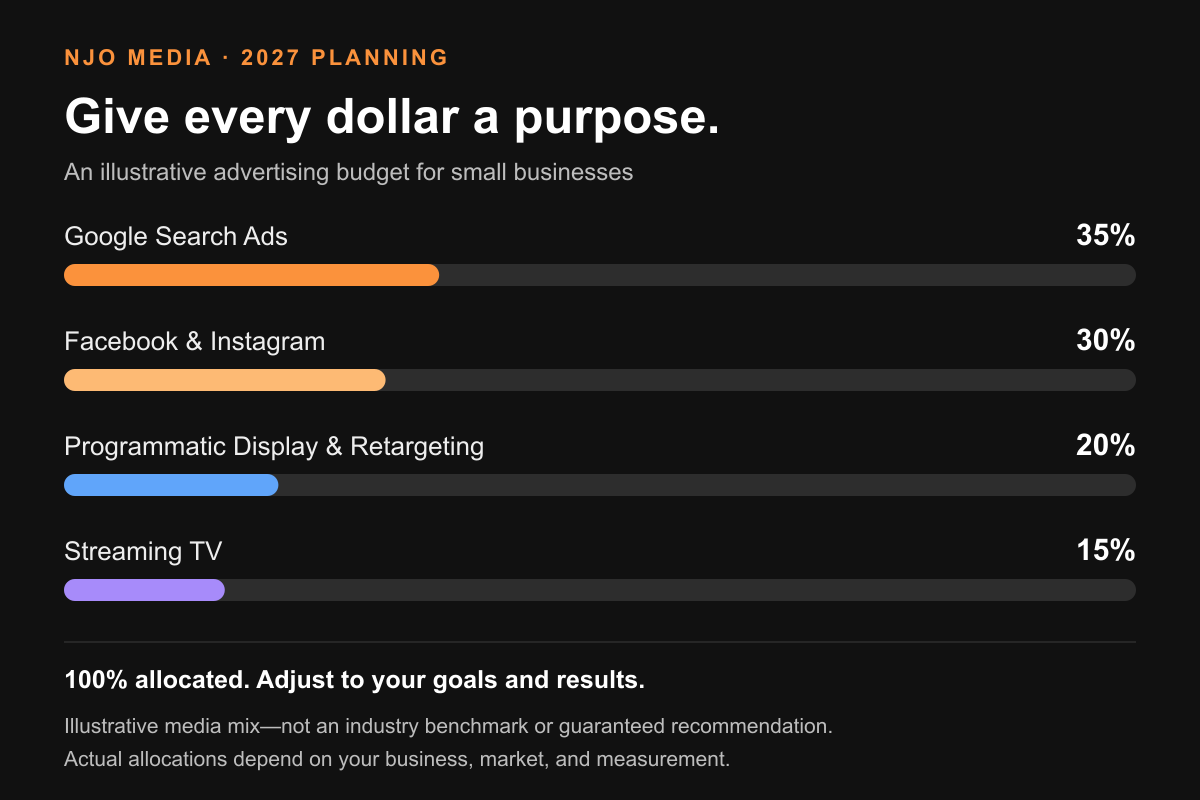
However, here's an illustrative starting point for a small business focused on both brand awareness and lead generation.
| Advertising Channel | Example Allocation |
|---|---|
| Google Search Ads | 35% |
| Facebook & Instagram | 30% |
| Programmatic Display & Retargeting | 20% |
| Streaming TV | 15% |
| Total | 100% |
This is an illustrative media allocation, not an industry benchmark or guaranteed recommendation. Actual allocations should be adjusted to campaign goals, channel economics, and measurement capabilities.
A business with immediate lead-generation needs may prioritize search and conversion-focused social campaigns.
A company entering a new market might allocate more toward awareness channels.
And a business with strong existing customer data may find additional opportunities through retention and reengagement campaigns.
The important thing isn't following a fixed percentage. It's understanding why you're investing in each channel.
7. Don't Forget the Power of Your Existing Customer Data
One of the most overlooked marketing resources is information your business may already have.
Customer email lists, purchase histories, CRM records, and other appropriately collected first-party data can help inform advertising strategies.
When used with appropriate permissions and privacy safeguards, this information may support customer retention, audience segmentation, and eligible advertising activation.
For example, a business might develop campaigns designed to reconnect with existing customers or reach new prospects with similar interests and characteristics, where supported by the advertising platform.
NJO Media Tip: Before investing heavily in acquiring new customers, consider whether your existing customer relationships offer opportunities for more efficient marketing.
8. Measure What Matters: Business Results
Impressions, clicks, reach, and video views can all help explain campaign performance.
But they aren't necessarily the final measure of success.
In 2027, businesses should aim to connect their advertising investments to meaningful outcomes such as:
- Qualified leads
- Appointment requests
- Phone calls
- Online purchases
- Physical store visits
- Customer acquisition costs
- Revenue and return on advertising investment
For businesses with physical locations, solutions such as Footfall Attribution may also help measure whether eligible advertising exposure is associated with subsequent visits.
The more closely your measurement aligns with your actual business objectives, the more informed your advertising decisions can become.
9. Think Omnichannel, Not One-Platform-Fits-All
Your customers don't live on one advertising platform.
They might discover your business through a Streaming TV advertisement, research your services on Google, see your brand again on Instagram, and finally contact you through your website.
Each interaction can contribute to the customer journey.
That's why a coordinated, omnichannel advertising strategy can be more useful than treating every platform as a completely separate investment.
At NJO Media, we believe businesses deserve marketing strategies built around their goals, not simply around whichever platform happens to be popular.
Our approach focuses on connecting audience targeting, creative messaging, media strategy, and performance measurement to help businesses make smarter advertising decisions.
Final Thoughts: Make Every Marketing Dollar Count in 2027
The question isn't whether Google Ads, Meta, Streaming TV, or programmatic advertising is the best platform.
The better question is: Which combination of advertising channels makes the most sense for your business?
A successful marketing strategy starts with understanding your customers, setting realistic objectives, selecting the right channels, and continuously measuring performance.
Whether your budget is modest or substantial, every dollar should have a clear purpose.
And the earlier you start planning, the better positioned you'll be to enter 2027 with a thoughtful strategy.
Planning Your 2027 Marketing Strategy?
At NJO Media, we help businesses develop tailored digital advertising strategies that connect the right audiences with the right message across multiple channels.
From paid search and social media to programmatic advertising and Streaming TV, we're here to help you make informed decisions about where your marketing dollars go.
Let's make your 2027 marketing budget work smarter.
Book your FREE 30-minute consultation with NJO Media today.
Smarter targeting. Better measurement. Real business outcomes.