
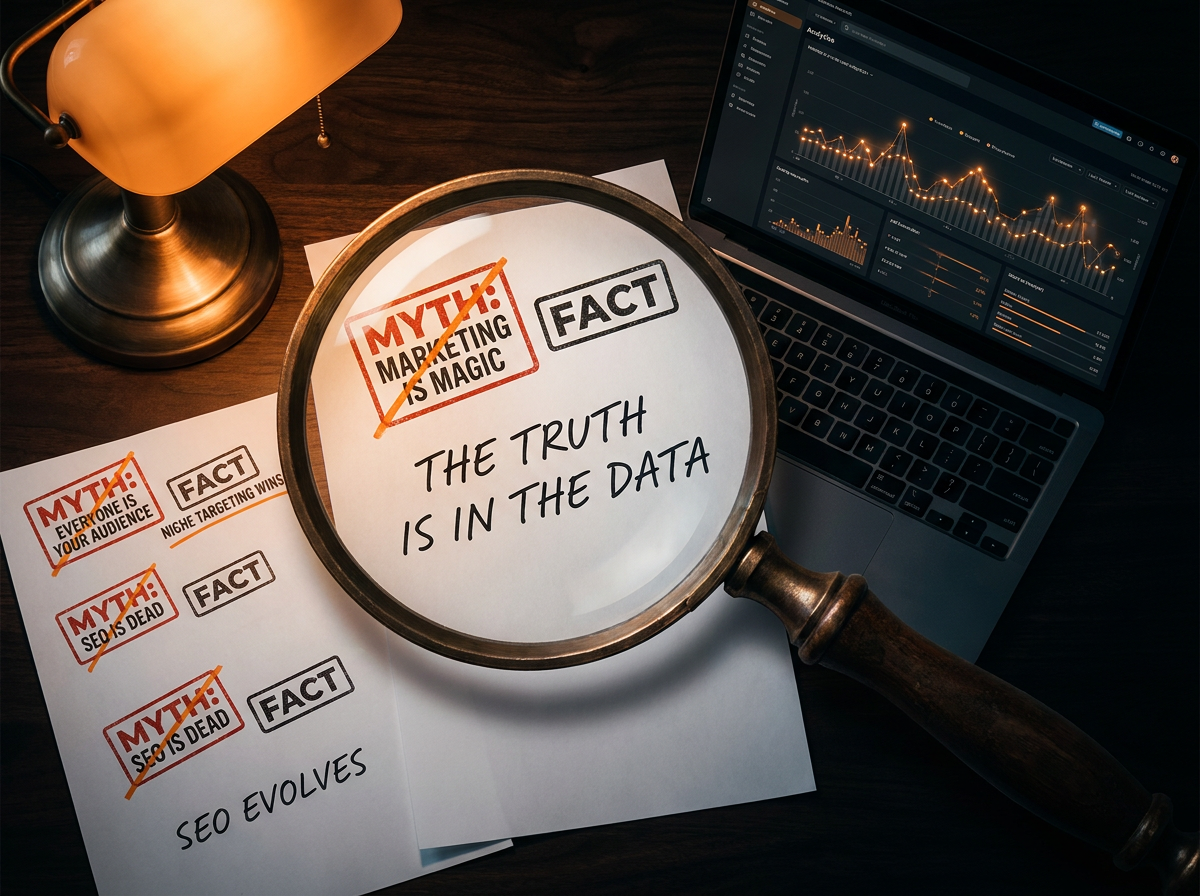
Digital marketing has come a long way, but some myths just refuse to die. We talk to local business owners across Southern Arizona every single week, and we keep hearing the same misconceptions — beliefs that sound reasonable on the surface but are quietly costing businesses real money and real customers.
Let's put these five stubborn myths to rest once and for all.
"SEO is dead — nobody uses Google anymore."
We hear this one more and more, especially with the rise of AI tools like ChatGPT. And while it's true that people are using AI to answer questions, Google still processes over 8.5 billion searches per day. That number hasn't gone down — it's actually gone up.
What has changed is how people search. They use longer, more conversational queries. They expect faster, more relevant results. And Google has gotten much better at rewarding businesses that provide genuinely helpful content over those that just stuff keywords into a page.
For local businesses, SEO is more important than ever. When someone in Tucson searches "best dentist near me" or "AC repair Southern Arizona," you want to be the one who shows up. That's not dead — that's essential.
The truth: SEO isn't dead. It's evolved. And the businesses that adapt are the ones showing up when customers are ready to buy.
"Email marketing is outdated and annoying."
A lot of business owners think email is a thing of the past — that nobody reads marketing emails anymore. But here's a stat that might surprise you: email marketing still delivers an average return of $36 for every $1 spent. That makes it one of the highest-ROI marketing channels that exists.
The key difference is how you do email. Blasting the same generic newsletter to your entire list every week? Yeah, that's annoying and people will unsubscribe. But sending a helpful tip to someone who just visited your website? Or a follow-up offer to someone who filled out your contact form but didn't book? That's smart, and it works.
Think of email as your follow-up system. Most sales happen after the 5th or 6th touchpoint. Email lets you stay in front of potential customers without being pushy — and it costs almost nothing to run.
The truth: Email isn't outdated. Bad email is outdated. Done right, it's one of the most powerful tools in your marketing toolkit.
"You need to go viral to succeed on social media."
This myth has probably done more damage than any other. Business owners see viral videos with millions of views and think, "If I could just get one of those, my business would explode." So they spend hours trying to create the next trending reel instead of focusing on what actually drives revenue.
Here's the reality: going viral almost never translates to paying customers for a local business. A video that gets 500,000 views from people across the country doesn't help if you're a plumber in Tucson. You don't need 500,000 views. You need 500 of the right people to see your message.
Consistent, targeted content that speaks directly to your local audience will always outperform a lucky viral moment. Post regularly, be helpful, be authentic, and let paid campaigns do the heavy lifting of getting your content in front of the right people.
The truth: Virality is a lottery ticket. Consistency and targeting are a paycheck. Build your strategy around the paycheck.
"My website doesn't matter — I get all my business from social media."
Social media is great for awareness and engagement. But here's what a lot of business owners don't realize: when someone sees your ad or your post on social media and gets interested, the very first thing they do is look up your website. They want to see if you're legit.
If they land on a slow, outdated, or confusing website — or worse, you don't have one at all — you've just lost a potential customer. They'll move on to the next business that looks more professional and trustworthy.
Your website is your digital storefront. It's where people go to validate their interest, learn more about your services, read reviews, and take action (call you, book an appointment, fill out a form). Social media gets people curious. Your website closes the deal.
The truth: Social media and your website work together. One without the other is like having a great billboard that points to a closed store.
"Digital marketing results should be instant."
This is the myth that causes the most frustration — and the most wasted money. A business owner runs a campaign for two weeks, doesn't see a flood of new customers, and concludes that "digital marketing doesn't work."
But here's how digital marketing actually works: the first few weeks are about gathering data. The platform is learning who responds to your ads, what times work best, which creative gets clicks, and which audiences convert. This learning phase is critical — and it takes time.
Most campaigns start showing meaningful results after 4–6 weeks. By month two or three, you're seeing compounding returns as the system gets smarter and your brand becomes more familiar to your target audience. The businesses that win at digital marketing are the ones that commit to at least 90 days and let the data guide their decisions.
The truth: Digital marketing is a marathon, not a sprint. Give it time, track the data, and the results will come.
The Bottom Line
These myths persist because they sound logical on the surface. But when you look at the data and the real-world results, the truth is clear: digital marketing works — it just works differently than most people expect.
The businesses that succeed are the ones that let go of outdated beliefs, invest in the right strategies, and give those strategies enough time to deliver. If you've been holding back because of any of these myths, consider this your permission to move forward.
And if you're not sure where to start, that's exactly what we're here for.
Ready to stop believing the myths and start seeing real results?
Book a free 30-minute call. We'll give you an honest assessment of what's working, what's not, and what to do next.